The 3D Scanner: Bridging Physical Reality and Digital Precision
In an era where the boundary between the physical world and digital design is becoming increasingly porous, the 3D Scanner has emerged as a pivotal tool for creators, engineers, and artists. It is no longer just a piece of industrial equipment reserved for aerospace or medical manufacturing; it has evolved into an accessible instrument that empowers individuals to capture reality in three dimensions. Whether you are a hobbyist looking to replicate a broken part, a marketer needing precise product visualizations, or a designer seeking inspiration from organic forms, understanding the capabilities and implications of 3D scanning is essential for modern workflows.
This technology allows users to translate tangible objects into digital mesh data, creating a bridge that facilitates reverse engineering, archiving, customization, and creative expression. As we integrate more digital tools into our daily lives, the ability to accurately digitize the physical world offers unprecedented opportunities for innovation and efficiency. The following sections explore the practical applications, evolving trends, and creative potential of this transformative technology.
From Industrial Necessity to Creative Enabler
Historically, 3D scanning was synonymous with high-cost, slow-moving processes used primarily for quality control in large-scale manufacturing. However, recent advancements have democratized access to this technology. Today, handheld scanners, structured light systems, and even smartphone-based LiDAR apps allow users to capture complex geometries with remarkable speed and accuracy. This shift has profound implications for various sectors, enabling faster prototyping cycles and more intuitive design processes.
For professionals in architecture, interior design, and construction, 3D scanning provides a rapid method for documenting existing structures. Instead of relying on time-consuming manual measurements, surveyors can walk through a site and generate point clouds that serve as the foundation for Building Information Modeling (BIM). This not only reduces human error but also accelerates project timelines significantly. Similarly, in the field of heritage preservation, museums and cultural institutions use these tools to create detailed digital archives of artifacts, ensuring that fragile items can be studied and appreciated without risking physical damage.
Practical Applications Across Industries
The versatility of 3D scanning extends far beyond traditional engineering. Its utility spans across diverse fields, each leveraging the technology to solve unique challenges and unlock new possibilities.
- Reverse Engineering: When original CAD files are lost or when dealing with obsolete parts, 3D scanning offers a solution. By capturing the exact dimensions of a physical component, engineers can recreate accurate digital models for modification or reproduction. This is particularly valuable in maintenance industries where downtime must be minimized.
- Custom Prosthetics and Medical Devices: In healthcare, precision is paramount. 3D scanners capture the unique contours of a patient’s body, allowing for the creation of custom-fitted prosthetics, orthotics, and surgical guides. This personalization improves comfort, functionality, and patient outcomes, demonstrating the humanitarian impact of the technology.
- VFX and Gaming: The entertainment industry relies heavily on realistic assets. Scanning real-world objects, actors, and environments allows artists to incorporate photorealistic details into digital worlds. This blend of physical and digital elements enhances immersion and reduces the time required to model complex textures and shapes from scratch.
- E-commerce and Product Design: For online retailers, accurate 3D representations of products can enhance customer confidence and reduce return rates. Designers use scanning to iterate quickly on product shapes, testing ergonomics and aesthetics before committing to expensive molds or production runs.
The Role of Visual Assets in Modern Communication
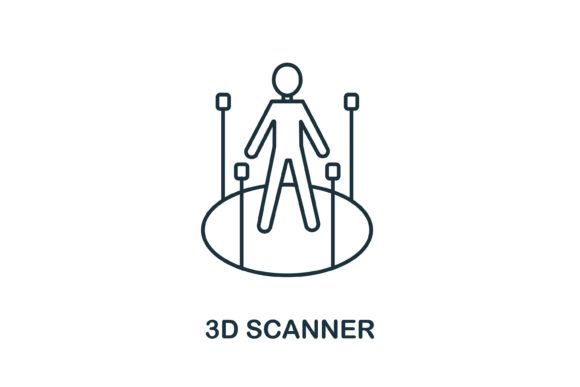
While the hardware and software behind 3D scanning are critical, the visual representation of the technology itself plays a significant role in how it is perceived and utilized in marketing and design. A well-crafted 3D Scanner icon serves as a powerful symbol of precision, innovation, and technological capability. These icons are not merely decorative; they communicate complex ideas instantly within user interfaces, infographics, and branding materials.
Consider the needs of web designers and content creators who need to convey concepts related to digitization, measurement, or 3D printing. A simple line 3D Scanner icon offers clarity and professionalism without overwhelming the viewer. Such symbols are essential for templates, web design, and infographics, where space is limited and visual hierarchy matters. They provide a universal language that transcends text, making information more accessible to a global audience.
Designing with Vector Graphics: Flexibility and Quality
When selecting visual assets for professional projects, the format and editability of the graphics are just as important as their aesthetic appeal. High-quality vector graphics ensure that logos and icons remain crisp at any size, from a favicon to a billboard. This scalability is crucial for maintaining brand consistency across different platforms and media.
Many resources now offer comprehensive packages that include both EPS file and JPG file formats. The EPS (Encapsulated PostScript) file is particularly valuable for designers because it contains vector data, allowing for easy editing of paths, colors, and shapes without loss of quality. This flexibility enables creators to adapt the icon to fit specific brand guidelines or design contexts seamlessly. Meanwhile, the JPG file provides a ready-to-use raster image for quick integration into presentations, social media posts, or web pages where vector editing is not feasible.
The emphasis on "Easy to edit and use" reflects a broader trend in the design community toward efficiency and customization. Professionals do not always have the time to build every asset from scratch. Having pre-made, high-quality vectors that can be slightly modified saves hours of work and ensures a polished final result. This approach aligns with the practical needs of freelancers, agencies, and small businesses that require professional-grade visuals but operate under tight deadlines.
Integrating Technology into Creative Workflows
The adoption of 3D scanning technology is reshaping creative workflows by introducing new stages of validation and iteration. Traditionally, the process of moving from concept to physical object involved multiple rounds of modeling, printing, and testing. With 3D scanning, creators can scan a prototype, compare it against the digital model, and identify discrepancies immediately. This feedback loop accelerates the development process and reduces material waste.
For educators and students, this technology offers hands-on learning opportunities that bridge the gap between theory and practice. STEM programs can incorporate 3D scanning to teach geometry, spatial reasoning, and digital fabrication. Students learn to appreciate the complexities of form and function while gaining skills that are increasingly relevant in the digital economy. The accessibility of these tools encourages experimentation and fosters a deeper understanding of manufacturing principles.
Future Directions and Realistic Expectations
As we look ahead, the integration of artificial intelligence with 3D scanning promises to further streamline the process. AI algorithms can automatically clean up noisy point clouds, fill in missing data, and optimize meshes for 3D printing. This automation will make high-quality scans more accessible to non-experts, lowering the barrier to entry for those interested in 3D modeling and fabrication.
However, it is important to maintain realistic expectations. While technology advances rapidly, challenges such as scanning reflective surfaces, transparent materials, and highly detailed textures persist. Users must understand the limitations of their equipment and choose the appropriate scanning technique for their specific subject matter. Success often depends on proper preparation, lighting conditions, and post-processing skills.
Moreover, the ethical considerations of 3D scanning cannot be ignored. The ease of copying physical objects raises concerns about intellectual property and security. As the technology becomes more widespread, users must navigate legal frameworks and respect copyright laws when digitizing and distributing designs. Responsible use of these tools is essential for fostering trust and sustainability in the digital ecosystem.
Conclusion
The 3D Scanner represents more than just a tool for capturing geometry; it is a gateway to a new way of interacting with the physical world. By enabling precise digital replication, it opens doors to innovation in engineering, art, medicine, and education. For designers and marketers, the accompanying visual assets, such as the simple line 3D Scanner icon, play a vital role in communicating these advanced capabilities clearly and effectively.
Whether you are utilizing an EPS file for a scalable logo or a JPG file for a quick infographic, the availability of high-quality, editable graphics supports your creative vision. As the technology continues to evolve, staying informed and adaptable will be key to leveraging its full potential. Embracing 3D scanning and its associated visual language allows us to move forward with confidence, turning abstract ideas into tangible realities with greater speed and precision than ever before.